








A Quiet Milestone, Sixteen Years in the Making
Some moments in medicine do not arrive with fanfare.
They arrive quietly – after years of careful work, accumulated experience, and a deep respect for science.
This publication is one of those moments.
In November 2025, a significant milestone was reached in non-invasive aesthetic medicine: the first peer-reviewed clinical publication on Ultherapy PRIME in an Asian population was published in Plastic and Reconstructive Surgery – Global Open.
On the surface, it is a clinical case series.
But for me, it represents something far more personal.
It marks the first published clinical evidence of Ultherapy PRIME in Asian patients – and it comes after sixteen years of working with Ultherapy, from the very first day the technology arrived in Asia.
This study is an important step forward not just for Ultherapy itself, but for Asian patients, whose skin structure, ageing patterns, and treatment responses remain under-represented in aesthetic research.
As one of the contributing authors, I felt it was important to explain not just what the study showed, but why it matters in real clinical practice – particularly for jawline definition and upper neck laxity, two areas that are notoriously difficult to treat without surgery.
Growing With a Technology, Not Just Using It

I began using Ultherapy at a time when non-surgical lifting was still viewed with skepticism. There were no shortcuts then – only anatomy, physics, patience, and clinical judgment.
Over the years, I have watched the technology evolve – not merely in power or precision, but in intent. Ultherapy was never about chasing dramatic change. It was always about working with the body’s own architecture, stimulating collagen where it matters most, and allowing results to unfold gradually and honestly.
Ultherapy PRIME feels like the natural maturation of that philosophy.
When the PRIME platform was introduced, I did not approach it with excitement alone. I approached it with scrutiny. I wanted to know whether it truly improved precision, whether patients would feel the difference, and whether outcomes in Asian skin would be measurable – not just anecdotal.
This study was our way of answering those questions with data.
Why Ultherapy PRIME Matters for Asian Faces
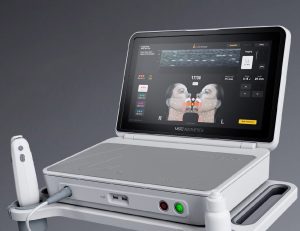
Ultherapy PRIME represents the next generation of microfocused ultrasound with real-time visualization (MFU-V). While traditional Ultherapy has been used globally for over a decade, Ultherapy PRIME introduces several meaningful technological refinements: faster and clearer ultrasound imaging, smoother energy delivery, more precise targeting of deep structural layers, and improved workflow efficiency for the treating physician.
Until now, there had been no published clinical data evaluating Ultherapy PRIME specifically in Asian patients. This study was designed to address that gap.
What We Saw and Why It Matters
At 90 days following a single Ultherapy PRIME treatment, the improvements were both visible and consistent.
Using validated clinical scales, 86.7% of patients showed at least a one-point improvement in upper neck laxity, while 70% demonstrated at least a one-point improvement in jawline definition. Patients who began with moderate laxity often experienced even greater change – in some cases, two full points of improvement.
But numbers only tell part of the story.
What mattered more to me was alignment: what physicians observed, what patients felt when they looked in the mirror, and what their faces communicated – without being altered.
On the Global Aesthetic Improvement Scale (GAIS), every single patient and physician rated the outcome as improved or better, many as very improved or very much improved. This level of concordance is rare – and meaningful.
Reduced Pain: A Meaningful Advance
One of the quieter breakthroughs with Ultherapy PRIME is comfort.
The average pain score in this study was 4.5 out of 10, noticeably lower than historical data from earlier Ultherapy systems. This matters, because comfort is not cosmetic – it is clinical.
Improved real-time visualization allows me to see exactly where energy is being delivered, and just as importantly, where it should not go. Sensitive structures such as bone can be deliberately avoided, rather than approximated around.
Shorter treatment times also play a role. When a procedure is faster, there is less cumulative discomfort, less physical tension, and less fatigue for the patient. The experience becomes calmer, more controlled, and more tolerable from beginning to end.
Most critically, greater precision means that energy is placed only where it is needed. There is less spillover into surrounding tissue, less unnecessary irritation, and a smoother recovery overall.
For patients who previously hesitated because of pain, this is not a minor refinement. It fundamentally changes how the treatment feels – and how confidently it can be undertaken.
Faster Treatment Times, Without Compromising Results
Another meaningful improvement with Ultherapy PRIME is treatment efficiency.
A full lower face and neck treatment now takes, on average, around 45 minutes, compared with the hour or more that was previously typical. The change may seem subtle, but its impact is felt throughout the entire experience.
This reduction comes from smoother image processing, clearer real-time visualization, and more seamless transducer transitions. There is less stopping, less recalibration, and fewer interruptions once treatment begins. The session unfolds in a more continuous, deliberate rhythm.
Clinically, this matters. Less time on the treatment bed means less physical strain for the patient and less cumulative discomfort. For the physician, reduced fatigue allows focus to remain sharp and consistent from the first line to the last. Energy delivery becomes more uniform, more intentional, and ultimately more precise.
The result is not just a faster treatment – it is a better one.
Safety Across Skin Types and Demographics
Ultherapy PRIME demonstrated consistent efficacy across Fitzpatrick III–V skin types, with no significant differences based on age, sex, or BMI. Patient satisfaction was high, and 96.7% of participants said they would recommend the treatment.
This reinforces its suitability for Asian skin, where safety, pigment stability, and controlled energy delivery are paramount.
What This Means for Patients
Taken together, this publication confirms that Ultherapy PRIME is not merely an incremental upgrade. It represents a meaningful evolution in how non-surgical lifting can be delivered.

Patients can expect clearer definition along the jawline, visible tightening of the upper neck, and a treatment experience that is more comfortable than earlier systems allowed. Sessions are shorter, yet outcomes are not compromised – a balance that is only possible when technology genuinely improves precision rather than simply speed.
Perhaps most importantly, these results are not anecdotal. They are supported by peer-reviewed clinical data in an Asian population, reflecting the anatomical realities of the faces we treat every day.
For patients seeking non-surgical lifting that respects structure, preserves identity, and delivers real change without surgery, this matters.
Final Thoughts
In aesthetic medicine, innovation should always be accompanied by evidence. This study represents exactly that – a data-driven confirmation that Ultherapy PRIME delivers real, measurable benefits for Asian patients, particularly in the lower face and neck.
As always, outcomes depend on proper patient selection, anatomy-guided planning, and experienced execution. Technology is only as good as the clinician using it.
Reference
Lim J, Siew TW, Xu Y. Early Experience With Ultherapy PRIME in Asia Pacific: A Pilot Case Series. Plastic and Reconstructive Surgery – Global Open. 2025.